

In March, the US President invoked a centuries-old provision in the American constitution, the Alien Enemies Act, to designate as terrorists drug producers and traffickers operating within that country and around the world. A White House release argued that drug trafficking constitutes a form of irregular warfare. This is a categorical escalation by Washington in its ongoing efforts to stop addictive substances with high mortality rates, particularly the opioid called fentanyl, being smuggled through US borders. It is extremely relevant to India, a country situated near one of the epicentres of the international drug trade, the Af-Pak region. It has also become apparent from world press investigations and internal investigations by US intelligence agencies, little reported in the Indian press, that China and Pakistan are deeply engaged, at the highest levels of government, in international criminal enterprises that produce and smuggle narcotics. The two hostile states on either side of the Indian union have dedicated enormous resources to destabilising it since their creation after the second world war. For much of this time, narcotics have played a central role in the irregular warfare they have waged inside Indian borders. But unlike Washington, New Delhi has not yet devised any robust plans to confront and persecute the criminal entities within the Chi-Pak establishments and their mafia affiliates in the international drug trade. At a time when drug addiction and fatality rates are increasing rapidly in border states like Arunachal Pradesh and Punjab, this governmental oversight is proving costlier by the day.
Chinese operations against the United States
Fentanyl is a synthetic opioid a hundred times more powerful than morphine, and fifty times more powerful than heroin. In the preceding decade, 2 lakh thirty thousand people in the United States are estimated to have been killed by drug overdoses including fentanyl.
In May this year, the Reuters news agency won the Pullitzer prize for damning reports connecting criminal drug enterprises producing and trafficking fentanyl to the Chinese Communist Party and Chinese state-owned banks. Reuters journalists found that the chemical precursors that are required to produce fentanyl, are being manufactured at scale in China and Chinese controlled facilities in Myanmar with the full awareness and cooperation of Chinese state officials. An official committee of the US Congress reported that the People’s Republic of China is openly subsidising the American opioid crisis. “The PRC (People’s Republic of China) scheduled all fentanyl analogues as controlled substances in 2019, meaning that it currently subsidizes the export of drugs that are illegal under both U.S. and PRC law,” the US Congressional report said.
The US report made use of data from the Chinese State Taxation Administration, which showed that the Chinese government offers rebates upto 13%. It also showed subsidies for precursor chemicals NPP and ANPP that criminal fentanyl producers use.
Starting in 2014, drug producers in Mexico began flooding America with the cheap, deadly substance in pill form. Fentanyl is often disguised to look like relatively weaker prescription pills and ingested unknowingly by the user. According to a study in the journal Pediatrics, fentanyl deaths quadrupled in the period 2018-2022. Addiction rates in the US are tapering off, with the country seeing a 40% decline in fentanyl deaths last year after years of the death toll hovering at 1,500-2,000. The improvement is partially attributed to greater awareness of the dangers of substance abuse and record-high abstention rates among teenagers in that country, in addition to the availability of better healthcare facilities and weaker forms of fentanyl being sold. However, the problem remains, not just in America but across the globe. World deaths involving synthetic opioids other than methadone, primarily fentanyl, stood at 73,838 according to the US National Centre for Health Statistics. Per the World Health Organisation, there were 1 lakh 25 thousand opioid overdose fatalities in the world.
The report issued in April by the House of Representatives’ select committee on China that calls that nation the “ultimate geographic source” of the fentanyl crisis.
The report went on to describe the reasons for the Chinese state to produce fentanyl ingredients and establish trade relations with the drug cartels making and sending the substance to the United States: ” The fentanyl crisis has helped CCP-tied Chinese organized criminal groups become the world’s premier money launderers, enriched the PRC’s chemical industry, and had a devastating impact on Americans.” The committee further found that even after official statements from Chinese officials promising a crackdown on the manufacture of fentanyl precursors in the country, thousands of Chinese companies are openly selling these illegal materials on the Chinese internet, “the most heavily surveilled country-wide network in the world,” and despite the CCP commanding “the most advanced techno-totalitarian state in human history” that leaves criminals with “nowhere to hide.”
China, which suffered a devastating opioid addiction crisis in its colonial period, is now using modern synthetic drugs in a strategic manner, working with Chinese and Latin American criminals to generate immense wealth for its chemical industry and banks. On the relationship between the Chinese government and organised crime, the US Congressional committee said, “Chairman Xi has intensified [the PRC’s] alliance with Chinese organized crime overseas… mix[ing] geopolitics and corruption for mutual benefit.”
Chinese operations in Myanmar and the Northeast
While Chinese drug precursors are turned into the final product by cartels in Latin America before being sent to the United States, Myanmar drug operations are a major origin point of drugs being trafficked to India, but Indian and international investigations indicate that these also work with the Chinese mafia and Chinese-backed armies. Arunachal Pradesh, Nagaland, Manipur, and Mizoram share a 1,624 kilometre border with Myanmar. Following the Myanmar military coup, the 2023 Organised Crime Index rated Myanmar the worst out of 193 countries, with the New York Times describing the country as the “global crime capital.” The Chinese have been the quickest to make use of the chaos in Myanmar, facilitated by the long history of Chinese organised crime’s involvement in gambling dens, scam centers and drug operations along the extensive Sino-Myanmar border, particularly in the Kokang region of Shan province, which abuts China’s Yunnan province and is populated by Han Chinese. But China’s involvement in the smuggling of drugs into India’s northeast is much more complex. For decades, the Chinese Communists have trained, indoctrinated and funded anti-India armies like the Naga NSC-IM, the Meitei PLA, the Zomi Revolutionary Army and others. Many of these, owing to the racial character of the region, operate across the India-Myanmar border. Naga separatists organised under the NSC-IM and other ethnic separatists, apart from receiving Chinese money and arms, have long raised funds to fight the Indian union by protecting and taxing poppy farmers in Myanmar. They also charge a ‘sovereignty tax’ for the smuggling of narcotic substances across the India-Myanmar border.
The Zomi Revolutionary Army, which is allied to the Myanmar junta and in conflict with the Chin National Army, which controls the better part of Myanmar’s Chin province, is one such group. The ZRA raises funds from poppy-growing operations in the Chin state. In recent years, tons of methamphetamines and other narcotics have been seized from Manipur and Mizoram. Increasingly, the nature of the illegal narcotics market in Myanmar has been changing, with the production of synthetic drugs increasing. This indicates a maturing narcotics economy similar to Latin America, especially since the coup. The UN Office on Drugs and Crime reported a 14% increase in the production of opium in the Chin state in 2023. With a large illegal Chin population living in Mizoram that has links across the border, this trend poses an obvious risk to India. The growing post-coup drug trade also ties into human trafficking, with children being preferred as mules to carry heroin and methamphetamine into Mizoram.
In this manner the growing drug crisis in the northeast is in large part a result of Chinese interference in India and Myanmar, where separatist organisations have been created and sustained by Chinese funds. These have, in turn, maintained a weak India-Myanmar border which permits the movement of men, arms, and drugs in both directions.
Mundra: anatomy of a Pak drug operation
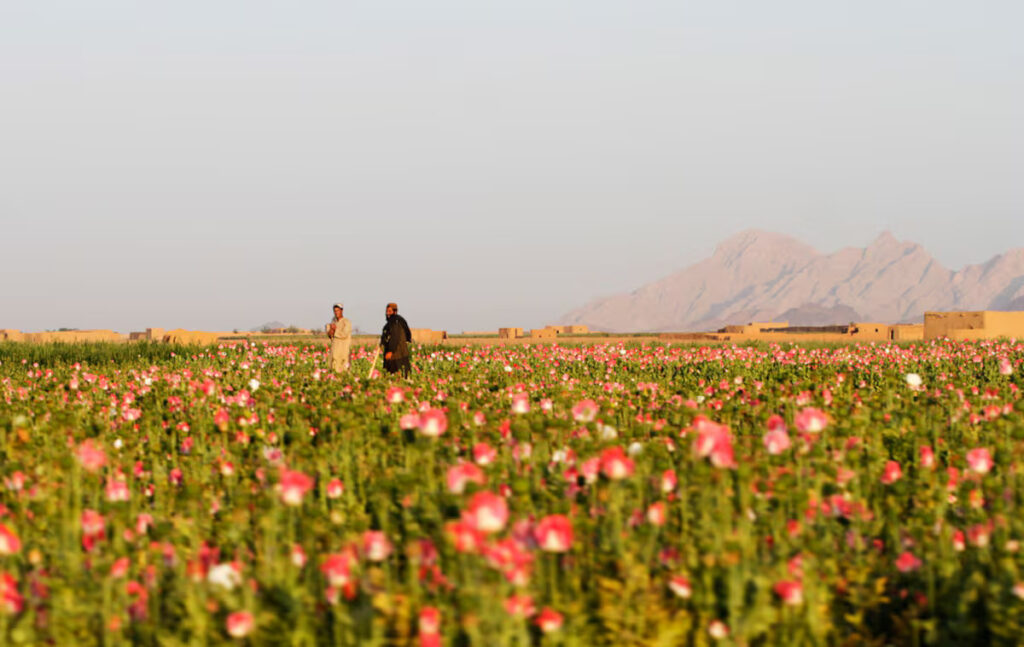
By 2021, Afghanistan was supplying 80% of the world’s opium. The Taliban has used the lucrative drug trade as a large source of revenue, and Afghanistan has long been at the center of world drug production and smuggling. Like Myanmar, simpler narcotic products like heroin are being replaced by more profitable synthetic ones, particularly methamphetamines, in Afghanistan. This trend reflected in seizures from the region in recent years. Smuggling routes are also changing. At present, more drugs are being smuggled from Afghanistan into countries on the Indian continent by sea than over land. The 2021 detection of 3000 kilos of heroin seized at the Adani port in Mundra, Gujarat, bears testimony to this. The Mundra bust is the largest in the history of Indian drug enforcement. More importantly, the Mundra bust revealed Pakistan’s central role in smuggling narcotics into India. The drugs, detected by the Directorate of Revenue Intelligence, were intended to fund the Pakistan state-backed terror outfit Lashkar-e-Tayiba, according to NIA testimony in the Supreme Court. The NIA testimony made reference to the deposition of a protected witness, who had been in contact with a member of the LeT proxy ‘The Resistance Front,’ since neutralised. According to the NIA affidavit, the heroin had been brought to India by a network consisting of Afghan traffickers, an Iranian middleman, and Pakistan’s ISI, which is the primary department of the Pakistani state overseeing terrorist outfits like the LeT and TRF. The profits from the heroin, routed through Iran disguised as talc powder and valued at ₹21 thousand crores, would have gone to the LeT and used to fund its operations.
The ISI came up working closely with the American CIA in the course of the Cold War, indoctrinating and arming mujahideen to fight the Soviet Union in Afghanistan. Along the way, the ISI appears to have picked up, as it were, several tricks from the CIA playbook. The CIA’s engagement in the narcotics trade in Latin America and its use of drug and arms smuggling to fund proxies on that continent and around the world is well known by now, but caused a stir when it was revealed in the infamous Iran-Contra affair of the 1980s. In the same period, the Pakistan establishment was hard at work raising drug revenue and siphoning American funds from the jihad in Afghanistan to fund its terror groups and nuclear program.
Now, Pakistan has achieved in India some of China’s success in the United States: making addicts of the citizens of another country and creating wealth to enrich its own criminal enterprises and state officials. By some estimates, the Pakistan illegal drug industry generates $2 billion a year, with a large share of Afghan opium and opium-derivates like heroin passing through the old frontier now called Khyber-Pakhtunkhwa (KPK). According to a government report, 266 people died in Punjab, which shares a long border with Pakistan, between April 2020 and March 2023. A 2015 AIIMS study estimated there were more than 2 lakh addicts in the state. All over India, between 2017 and 2019, 2300 people died from drug use. On the other hand, unlike China, Pakistan has made addicts of its own people. Per the UN, there are some 76 lakh drug users in Pakistan. The UNODC estimates 2 million, or 20 lakhs, of these to be addicts. This is the highest addiction rate of any country in the world. A Canadian think tank, the International Forum For Rights And Security (IFFRAS), reported that “the number of people who die of drug addiction [in Pakistan] is higher than those who get killed in terror attacks.” Places near the Afghan border like Peshawar are overrun with heroin addicts, and sharing syringes has also created an HIV epidemic in the country.
When it comes to narcotics, America has one border problem and India has two. Stuck between the Golden Crescent of Af-Pak & Iran and the Golden Triangle of Myanmar, Thailand and Laos, two of the deadliest drug-producing regions of the world. The hostile states of China and Pakistan are actively directing the drug trade against India as part of their destabilisation efforts against the largest democratic nation on earth. To turn the tide before the rot sets in, New Delhi needs to take executive action exceeding recent US presidential decrees designating drug producers and smugglers as terrorists and possibly freeing up US enforcement agencies and the US military to treat them in the same manner.