


A report by the Center for Science & Environment (CSE), a Delhi think-tank, showed that India suffered 3000 deaths, the loss of 20 lakh (2 million) hectares of crops and 80 thousand houses in 2024 because of extreme-weather events.
The IPCC (the Inter-Governmental Panel on Climate Change) defines an extreme weather event as “an event that is rare at a particular place and time of year.” Extreme weather events can be extremely hot or cold days, hurricanes, or extreme rainfall. The most frightening part of the CSE report is that in the year 2024, different places in India experienced extreme weather events on 88% of the days.
India’s agriculture remains monsoon-dependent and primitive in terms of technology and farming techniques. Fluctuating prices routinely impact even the middle classes, and for the poor securing good quality food is an everyday battle even in years that don’t see widespread crop failure.
In these circumstances, it is easy to apprehend the shape of India’s agricultural future in relation to extreme-weather related crop failures. For the foreseeable future, each year will exceed the previous in average temperature. Hotter, longer summers are terrible for agriculture whether they are combined with unusually heavy or unusually scarce rains. Extreme-weather events already occur all year round, and extreme-heat days are set to occupy most of the Indian summer. The writing is on the wall: farming in India cannot continue in the present manner.
Fortunately, government and private enterprise around the world and in India have been at work for decades developing a way of farming that is invulnerable to the most adverse weather conditions: greenhouses. The technology is well developed and ready for Indian agriculture to adopt at scale. The basic principle of greenhouse agriculture is simple, putting up glass or plastic covers to completely or partially insulate the crop. Greenhouse farming opens up many possibilities beyond its most commonly-known functions, the trapping of heat and humidity and the protection of crops from pests and the weather. For example, fully atmosphere-controlled greenhouses can recycle most of the water that goes into irrigation, offering a way forward in places that suffer water scarcity, as large parts of India do and will do in the future. Vertical farming, especially for crops already grown on the vine like the tomato and the cucumber, can be grown at much larger volume in a greenhouse than an open farm occupying the same land. At its cutting edge, the greenhouse industry is preparing for farming on Mars.
But for now, it would serve India well to start catching up to other earth-bound nations in implementing greenhouse technologies to protect its farmers and its consumers against the rapidly degrading environment. For the country with the largest domestic demand for food, India is far behind the curve.
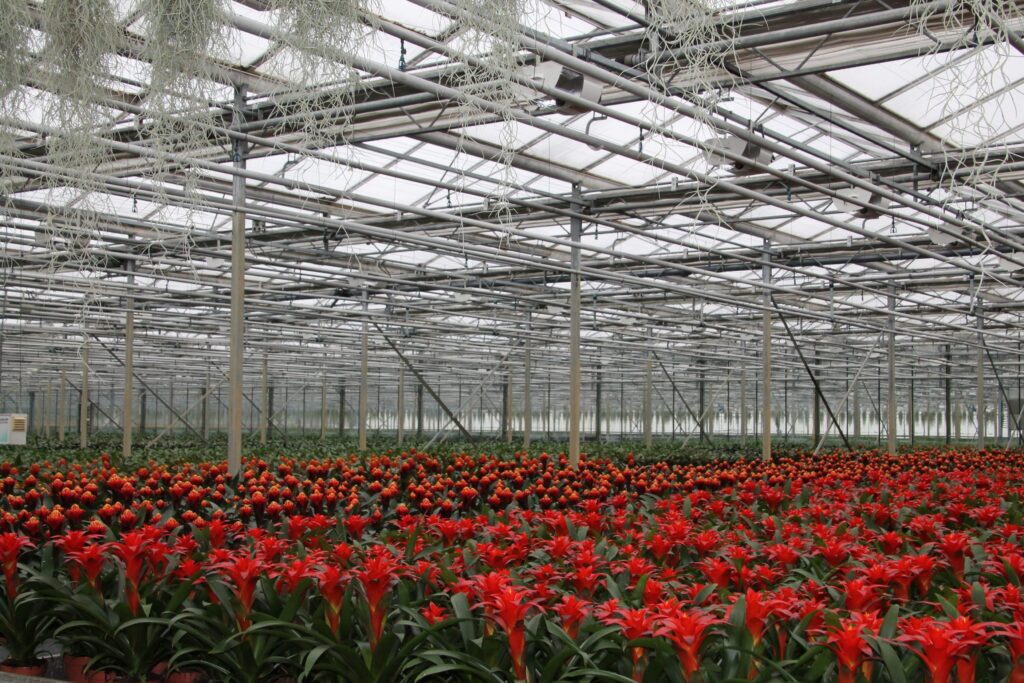
The total area under “protected cultivation” in India is variously estimated to be between 25 and 50 thousand hectares, or 250 and 500 sq. km. The lower estimate is comparable to the greenhouse cover of the Netherlands, a country the size of Haryana, which stands at 105 sq. km. In 2021, the Netherlands exported a record $108 billion worth of agricultural products, more than double the value of India’s agricultural exports that year, $50 billion. The extremely disproportionate value of Dutch agricultural exports is due to the pioneering work of the Dutch greenhouse industry, research establishments and government funding. The Netherlands has been at the forefront of greenhouse technology since the industry’s inception. The Dutch devised the first light-weight wood-frame glass walls, called the Dutch Light Frame, in the 19th century and also set up the world’s first dedicated schools of horticulture in the same period. While it is important to note the high value of Dutch agri-exports vis-a-vis India’s is also due to the much smaller domestic demand of the Netherlands, it is glaringly obvious that India has not tapped into its greenhouse potential for domestic use or exports when compared to smaller or larger nations.
According to satellite data analysis published in the journal Nature Food, greenhouses now cover 13,000 sq. km. of land, more land than the state of Tripura. Forty years ago, the figure stood at 300 square kilometres.
Much of this rapid expansion may be credited to China, where the government has aggressively pursued greenhouse agriculture. China accounts for 60% of the world’s greenhouses. The Shandong province in northern China is home to the largest greenhouse cluster in the world, clocking in at 820 sq. km. The Shandong plains in China exceed all of India’s greenhouse cover.
Much can be learned from the Dutch, who have led the world in climate-control, including the use of ‘climate computers’ to process sensor data to control temperature, light and CO2 levels in real time. The Netherlands and other countries have also made remarkable strides in minimising energy requirements, reusing water and continually increasing greenhouse yields with the same inputs. All of these innovations will have immediate results when used to address the deficiencies of Indian agriculture. The Dutch government has created a singularly fruitful support structure through extensive subsidies and grants to give farmers access to the best equipment and foster sustainable practises, collaborating with private enterprise and universities to drive cutting-edge research and implement it. The Netherlands also has tax incentives in place to encourage the adoption of new technologies and best practises in the industry.
The Government of India has taken steps to allow Indian farmers and researchers to learn from the Dutch. In collaboration with the Netherlands, Indo-Dutch Centers of Excellence have been operationalised around the country. They offer Indian farmers the opportunity to learn about the latest technologies directly from industry leaders from the two countries. But on an institutional level, government spending on greenhouse research and subsidies is still meagre. The Dutch have lead the world in minimising water use in agriculture, and aim to make their greenhouses pesticide-free by 2026. In addition to maximising production per acre of land for crops as vital to Indians as onions and tomatoes, these are all practises that can completely transform Indian agriculture.