

In January 1972, the humiliated Zulfikar Ali Bhutto presided over a gathering of nuclear scientists and engineers in the Multan province of Pakistan. There, he promised that Pakistanis would eat grass if they must but they will have their nuke. Today, the Pakistani state has made good on the second promise, and very nearly on the first. Two of the most rabid exponents of the ‘Islamic bomb,’ AQ Khan and Bashiruddin Mahmood were not present at the meeting. AQ Khan, then in Europe, was instrumental in the Pakistan nuclear program for his theft and procurement of centrifuges and other technologies to enrich uranium and finally build the bomb. In the nebulous non-proliferation regime of the 1970s and with the protection of the Americans, Khan was able to import entire dies used to cast centrifuge parts. He was bankrolled by the BCCI, the infamous Pakistani bank which was flush with billions deposited by a consortium of Western and Eastern businessmen and Muslim leaders including Libya’s Gaddafi and Sheikh Zayed of Abu Dhabi.
What is not as well known is the fact that China spoon-fed the Pakistanis blueprints and technical training leading up to Pakistan’s first nuclear weapons tests, largely with an eye to putting India in a chokehold within the region even as the Chinese started building capabilities to expand influence all over Asia and Africa.
Fourteen years after the Multan meeting, a Pakistani C-13 Hercules flew from the Chinese city of Urumqi with five steel boxes filled with enriched uranium, enough to make two nuclear bombs. This was revealed to the public in 2009 after AQ Khan’s personal documents were accessed by the Washington Post.
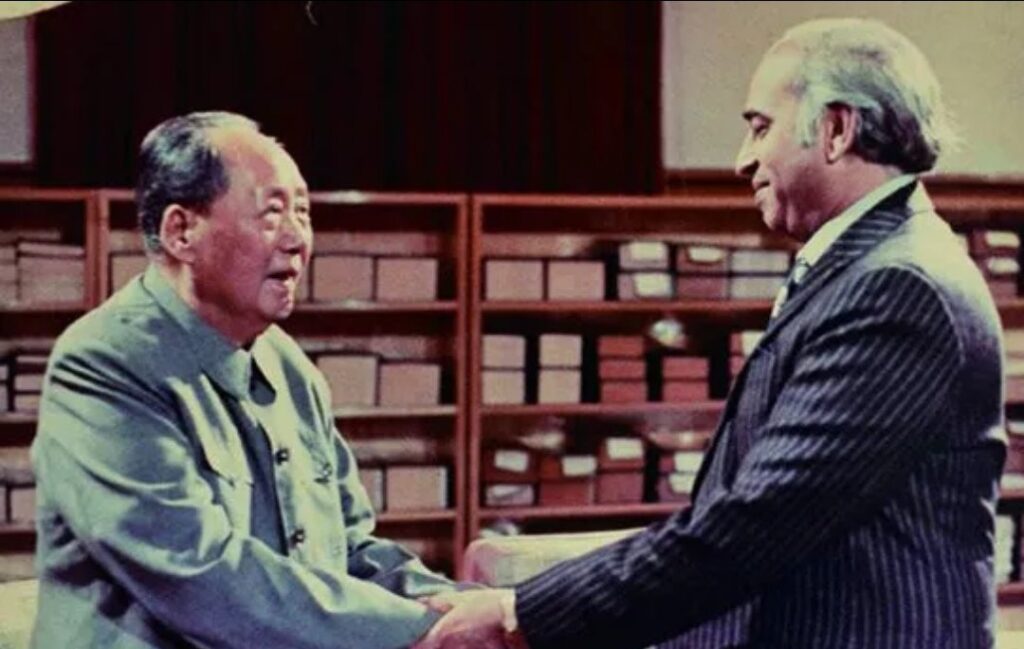
Without Chinese help, there would not be a Pakistani bomb. Nor would there be further proliferation across West Asia and the distinct possibility of terrorist groups taking control of nuclear weapons. The nuclear sharing arrangement that made this brazen act of proliferation possible was part of a secret nuclear agreement signed by Bhutto and Chinese dictator Mao Zedong soon after the Multan meeting.
The backing of the Chinese and the belief of American support led Bhutto’s murderer and successor Zia ul Haq to inform an interviewer in 1986 that “it is our right to obtain the technology.”
Two years later, Zia, his Chief of Staff Akhtar Rehman and the US ambassador to Pakistan were killed by a bomb while flying in a helicopter. By this time, Pakistan’s nuclear program had reached critical mass. In 1998, ten years after Zia’s death and twenty years after Zulfikar’s, the first Pakistani atomic bomb went off in the hills of Balochistan. Until 1998 and afterward, Pakistan received blueprints, parts and training from the Chinese and the North Koreans, who in their turn had also received the same assistance from China. The North Korean and Pakistani nuclear programs proceeded in parallel and were both presided over by the Chinese.
Khan said that the 1982 uranium shipment came with blueprints to build a simple nuclear device, identical to the bomb China had exploded in 1962.
In an 11-page account of China’s decisive help in creating the Pakistani bomb written in January 2004, Khan stated, “Upon my personal request, the Chinese Minister . . . had gifted us 50 kg of weapon-grade enriched uranium, enough for two weapons.” In a note to his wife written at the same time, Khan said,”The Chinese gave us drawings of the nuclear weapon, gave us kg50 enriched uranium.”
The favour went both ways. Khan, a metallurgist by trade who was engaged in the manufacture of centrifuges in the Netherlands, offered his services to Bhutto immediately after India’s first tests at Pokhran. Following Mao and Bhutto’s verbal agreement in 1976, Khan began working closely with the Chinese. At Mao’s funeral, he offered European technology that he had procured to the Chinese to accelerate their uranium-enrichment program. “Chinese experts started coming regularly to learn the whole technology” from Pakistan, Khan stated. Pakistani experts also travelled to central China, where they built a centrifuge production plant for the Chinese. It took 135 flights of the reliable Hercules to transport the equipment for it, per Khan’s accounts to his wife. China sent Pakistan fifteen tons of uranium hexafluoride in return. Khan said that the Pakistanis were struggling to produce the uranium gas themselves, and the Chinese shipment permitted them to produce their first weapons-grade uranium in 1982. Fearing strikes on its nuclear sites by India and Israel, Zia travelled with Khan to Urumqi aboard the Hercules to pick up the weapons-grade uranium.
In 2025, India finds itself between two nuclear-armed hostile powers. In the east, China has shaped the Korean Peninsula in the same fashion, giving democratic Japan and the Republic of Korea a nuclear-armed Pyongyang to contend with. The North Korean missile program, also built up with Chinese blueprints, is now mature enough to strike the continental United States across the Pacific. AQ Khan and his army of nuclear scientists provided nuclear weapons technology to Iran and Libya over decades. Gaddafi was toppled and the Libyan nuclear program ended with him. In 2004, the European and American intelligence agencies and the International Atomic Energy Agency confirmed that Pakistan was the source of crucial technology, key blueprints and equipment for a pilot Iranian uranium-enrichment plant. IAEA inspectors found that Iranian blueprints depicted a centrifuge type that bore a striking resemblance to the ones AQ Khan put up in the uranium enrichment plant at Kahuta. The current crisis in West Asia may be traced in large part to this assistance. China is at the center of this story of criminal nuclear proliferation. Giving Pakistan its nuclear umbrella, the Chinese have kept India occupied by a failing state. Nuclear weapons have allowed the North Koreans to directly threaten the United States, still the most powerful nation on earth, and its Pacific allies. These and other benefits have accrued to the Chinese at little cost to themselves. Its democratic rivals preoccupied, the Chinese have secured for themselves considerable space to create economic and military influence in the Indian continent and in East Asia. Having achieved similar influence in Iran, China is now offering the Islamic Republic whatever assistance it can in mitigating US-led sanctions. On June 26, Iran’s defence minister expressed his country’s gratitude to the PRC at the Shanghai Cooperation Organisation meeting held in the Chinese coastal city of Qingdao. The minister said he “hopes that China will continue to uphold justice and play an even greater role in maintaining the current ceasefire and easing regional tensions.”
In strategic, hard-power terms, when the CCP began building up its criminal nuclear regime all those decades ago, it could not have conceived of a better outcome.