

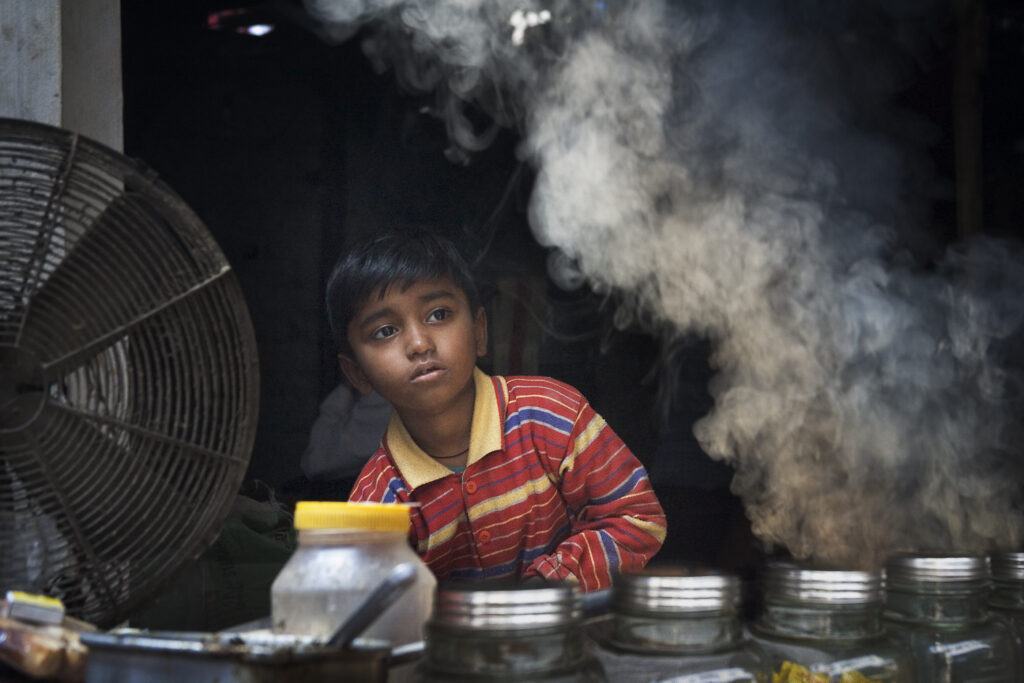
The warming climate is not a factor in India’s politics, but it is a factor in ruining the bodies of Indian children and stunting their growth. Why is no one talking about it?
A peer-reviewed study published in June 2021 found that a higher number of underweight, stunted and anemic children aged five reside in districts which are more vulnerable to climate variability.
In this study, it is the vulnerability of agriculture to climate change that is being referred to, as opposed to more general vulnerabilities like poverty.
Agricultural vulnerability to climate change is generally measured in terms of how much farmers can or cannot keep producing in elevated temperatures, how sensitive to heat the crops are, and how much farmers can adapt to the changing climate by, for example, using more heat-resistant crop varieties or changing the crop altogether.
The numbers are extreme. Compared to a low climate-vulnerability district, in a high climate-vulnerability district a child is 32% likelier to be stunted, 42% likelier to be wasted (generally defined as more than 2 standard deviations below the average weight-to-height ratio), 45% likelier to be underweight and 63% likelier to be anemic. India leads the world in the number of wasted children in a country, and the PLOS One study shows that the climate will only worsen this crisis.
Heat maps from the study show that the clusters of high malnutrition and high climate vulnerability exist predominantly in west-central India. Global warming, a phenomenon rebranded ‘climate change’ in the 1980s, is extremely dangerous to India. India has a long history of famine and starvation because of the dependence of Indian agriculture on the monsoon rains. The unpredictability of the rains, sometimes scarce and sometimes excessive, routinely destroys crops around the country. Global warming is already making the monsoons more unpredictable, and also contributing to heatwaves, droughts and rising temperatures. In India, farmers largely fall into two categories— small and large. The former are typically extremely poor and farm very small tracts of land. They try to farm enough to feed themselves and sell whatever remains of the harvest. Despite the size of their land and the negligible profits from their produce, India’s small farmers take out loans to buy seed and agricultural implements and remain deep in debt. Often, their only way out of that debt is suicide. Unseasonably low rainfall is often a death sentence. On the other hand, large farmers use groundwater and irrigation canals to farm large plots with hired labour, tractors and combine-harvesters, more in step with farming in developed countries. Unfortunately, for the large farmer too a rise in temperature of a degree or two would prove ruinous. This is due to monoculture, or the use of genetically identical seeds for a crop throughout the world. These are bred for certain desirable characteristics, like the taste and texture of wheat, the length and sweetness of the banana, and so on. The problem? Every farm growing the same seed supplied by the same company in the entire world is vulnerable to the same deadly pathogens, whereas in the past some diverse local breed or the other could be found that was genetically resistant or immune. Seed diversity gave the farmer many options to choose.
Similar to pathogen-vulnerability, all plants have a genetic threshold of heat-tolerance beyond which they will perish. In India, the small and large farmer both grow the same strains of wheat and other crops, and after a certain point they will succumb to the same level of heat. I should be extremely clear: this is not a class issue or a farmer issue: this is a staying alive issue. The children of India’s numerous poor have the bad luck of being born to a race apathetic to the suffering of its own. But the rest of us should not be in two minds about global warming: life is going to get very hard, doubly so if India continues to not listen to those raising the alarm. And even if you’re one of the few who are used to buying their way out of the rest of the country’s struggles, you’re going to feel the heat on this one.